Wednesday, 20 November 2013

European Erotic Cinema of the 1960s


I gave a paper at the Cine Excess VII conference held in Birmingham last week. The title was "Dolls of Vice: Eurotica repackaged for early 1960s British Audiences", and it focused on some of those European sexploitation films that were imported and shown in British cinemas. I chose Gala Film Distributors as my main case study, but as you can see to the right, Compton got a mention as well.

You can read the paper over at my Academia.edu page.

I am planning to develop this paper into a journal article and then a chapter for my PhD, so I'll be adding more information on Compton plus some other distributors like S.F. Films and Planet Films.

The conference itself had been moved from it's previous home in London, and from my experience last week it was a mistake. The attendance was quite tiny. It was a co-production between the University of Birmingham and Brighton University, and they didn't even seem to attract Birmingham uni students to it! I hope next time they do it in Brighton, which is much more a natural home for a conference like Cine Excess.


Thursday, 14 November 2013

Witches, Masked Heroes and Super Spies

Recently I've been trying to watch films that are from the area I've been studying. I'm convinced that a lot of the movies I have unearthed are lost, but it is surprising what is out there.

The Demon, or Demonia, or even Il Demonio, from 1963, is a bizarre film that I managed to find on YouTube. The version I found had English subtitles, but it looks like that one is gone now. You can still take a look at it here. It's the tale of a girl who might be a witch, or simply mentally ill. Lavi's performance is incredible.


Another strange, disturbing film is Young Aphrodites, also from 1963. I found information on this whilst researching Gala Film Distributors at The Cinema Museum. I've watched a bit of it, but the whole thing is available, again without subtitles, on YouTube.


What is striking about this film is its reputation as an erotic classic. The press book screams erotic and art house credentials, despite the film essentially being about the sexual awakening of a ten year old boy and a twelve year old girl. In some ways it's like an early The Blue Lagoon (1980), only even more disturbing, particularly when you read that the leads were not professional actors.


On a more fun track, this has been a good excuse to check out some Eurospy films. Our Man in Jamaica (1965) is a Spanish/ Italian/ West German co-production, with input from Mel Welles, of Roger Corman-fame. It has all the Bond elements: pretty girls, an overblown villain, a confident-to-the-point-of-arrogance hero and exotic locations. However the story is actually fairly pedestrian, and it has none of the visual flair that the Bond films are known for.


Recently I picked up on DVD a couple of ultra-rare and obscure European comic-book movies. The first, Superargo contro Diabolikus, or Superargo Against Diabolikus (1966) is like a cross between a Mexican wrestler film and James Bond. It was clearly made in the mould of the Italian comic book heroes, who would soon achieve international acclaim in Mario Bava's Danger: Diabolik! It really is a lot of fun.


 The other film I found was Batwoman, or The Bat Woman (1968), which was being sold as Spanish, but may actually be Mexican. Either way, it looks pretty nuts. I'll let you know.


Sunday, 22 September 2013

Young Love (1961)

A couple of days ago I came across a set of FOH stills (front of house) for a Finnish film distributed in 1961 by Bargate, a particularly obscure distributor that I currently know nothing about. The rear of the pictures are stamped "Girosign Ltd" with the address 88 Wardour St, W1 given.


The Film was originally titled Poika eli kesäänsä and was made in 1955. The literal translation is "The Boy of Summer", but Young Love has much more potential for exploitation, as did the X certificate it received. Films often took a few years to be picked up in the UK, particularly around this period, so it is no surprise that it took six years to be released here. The plot is described in the December 1961 issue of Monthly Film Bulletin as follows:

"Schoolboy Elias returns home for the summer holidays to his village and his devoted childhood sweetheart Lilli. She willingly allows herself to be seduced by him on midsummer night, but is so upset by the experience that she turns from Elias, who makes up for lost time with Olga, the flirtatious daughter of the village squire. Olga then marries the man of her father's choice. Under the impression that Lilli is pregnant, Elias proposes to her, but she turns him down and he returns to school."

So fairly standard sexploitation morality tale then, spiced up for the UK audiences who associated Scandinavian film with sex. The reviewer references a mild striptease and a couple of strenuous love scenes, which coupled with the adolescent angle was surely gold for Bargate. Perhaps audiences were not ready for that sort of behaviour in 1955.   

I am not sure whether this film is available anywhere. It doesn't seem to be, and is another example of an international film which has been lost down the cracks of time.


Update 13th october 2013

I have just visited the BBFC to search in their archives for Gala film titles (a blog post on that will be coming soon). Whilst I was browsing their Minutes of Exceptions for 1961 I came across the exceptions for Young Love:

Remove the close or medium close shot of Lili nude at the lake, i.e. when she is sitting on the landing-stage.
Remove all shots of men having a sauna bath.
Remove the lines "The brides go and get scrubbed for the wedding" and "You'll need it" and all the shots of the women in the sauna bath.
Remove also the girl's line in which she suggests that Olga will need clean sheets for her marriage bed.

Being a Finnish film I guess it should be no surprise that there would be scantily-clad sauna scenes.


Thursday, 19 September 2013

Sexploitation and Norman J. Warren

My research interests have always lain in the 1960s. I'm not entirely sure why, but that decade holds endless fascination for me. Before I started looking at international cinema, I spent a long time writing about British film in that decade. In 2010 I gave my first ever paper at a conference, and it was on Norman J. Warren's then unknown early sexploitation films. Since then, and I like to think partly thanks to my work, the BFI put Her Private Hell out on blu ray and DVD as part of their Flipside range. I was invited to contribute to the booklet for that release and attended the cast and crew screening, which was very exciting.

I have now uploaded that paper plus the imagery on my Academia.edu profile, so you can now read it, should you be so inclined. You can find it here.


(still from Loving Feeling (1968))


Thursday, 29 August 2013

1961

Today I've been through the Monthly Film Bulletin index for 1961 to catalogue all the international films reviewed in that year. This is the most complete record I have found to work out what was distributed. The MFB were very thorough and reviewed virtually every film released every month, and they also include production and (most importantly for me) the distributor.

In 1961 there were one hundred and forty-eight international films distributed and seen by British audiences. Sixty-two of these are some form of co-production, the most common being France and Italy. The variety of countries that had films shown here is quite astonishing. It is no surprise to find Italy and France, but also in cinemas were films from Pakistan, Kenya, East Germany, Brazil and many more. Twenty-two different countries in total.

There are some hilarious titles in there, such as The Cow and I (La Vache et le prisonnier), a France/ W. Germany co-production, or the exciting Death Comes From Outer Space (La Morte viene dallo spazio), an Italian/ French co-production, and possibly Italy's first science fiction film.

Amongst the films of 1961 are a few that were distributed by Compton Films, including Assassins in the Sun (Assassinos), from Brazil, and The Captive (Vacances en enfer) from France.


There are no prizes for guessing why the Italian I Piaceri del sabato notte, which translates as "the pleasures of Saturday night", was retitled Call Girls of Rome by Gala Film Distributors. This kind of import was something of a speciality for Gala, and I expect to see their name crop up frequently amongst the sexploitation titles.


These are scans of press books that I found amongst the vast collection at the Cinema Museum. I need to go back there some time soon.


Friday, 23 August 2013

Isabel Sarli

One of Compton's discoveries in the mid-1960s was the Argentinian actress Isabel Sarli. Working with her husband, film director Armando Bo, she rapidly became a star thanks to her "give it to me big boy" eyes and her propensity to shed clothes whenever possible. It is surprising given the strict Catholic sensibility of her home country, but these were qualities that Compton were certainly keen to exploit here in the UK. Below is an example of typical Compton marketing; self-promotion as news.


Tony Tenser always claimed to have dubbed Brigitte Bardot "sex kitten" when he marketed And God Created Woman (1956) for Miracle Films. He was at it again here, with Sarli becoming "The Goddess" in yet another tempting offering.


Sadly the movies themselves are difficult to see now, at least with English subtitles. Isabel Sarli is still alive, and someone recently made a Spanish language documentary about her. She is more-or-less forgotten over here now, a footnote in international cinema, but she was certainly a hit in the 1960s. Tony Klinger, an employee of Compton, remembers meeting her when she visited the UK to help promote her films. She was as stunning in real life as the pictures from this press release suggest.


Amidst the relics of the Compton archive I found a packet of materials on Isabel Sarli, including press cuttings from Argentina and a showman campaign created by Steve Prentoulis Films of New York, so she clearly made some sort of impact in the States.

Im not sure whether Isabel Sarli will figure large in my PhD, but she is another example of the diversity of choice in British cinemas in the 1960s.


Wednesday, 31 July 2013

Literature Review

I thought it may be of interest to someone out there if I posted my bibliography on here. This is not meant to be the definitive word on the topic under investigation, but I hope it's fairly thorough.


Bibliography

Barker, M. and Brooks, K. 1998, Knowing Audiences: Judge Dredd: Its Fans, Friends and Foes, Luton, University of Luton Press

Bayman, L. and Rigoletto, S. eds. 2013, Popular Italian Cinema, 2013, Chippenham, Palgrave Macmillan

Benzel, T. 2012, Muchas Gracias Seňor Lobo: Paul Naschy Memorabilia, Birkenfeld, Kessler & Benzel GbR

Bergfelder, T. 2005, International Adventures: German Popular Cinema and European Co-Productions in the 1960s, Oxford, Berghan Books

Branaghan, S. edited by Chibnall, S. 2006, British Film Posters: An Illustrated History, Cambridge, BFI/ Cambridge University Press

Chapman, J., Glancy, M. and Harper, S. 2007, The New Film History: Sources, Methods, Approaches, 2007, Basingstoke, Palgrave Macmillan

Chibnall, S. and McFarlane, B. 2009, The British 'B' Film, Camberley, BFI/ Palgrave Macmillan

Chibnall, S. 2013, 'Rome, Open for British Production: The Lost World of 'Britalian' films, 1946-1954', Historical Journal of Film, Radio and Television, 33:2, 234-269

Creepy Images [journal] available through: www.creepy-images.com 

Davies, R. R. 2011, Kiss Kiss Kill Kill: The Graphic Art and Forgotten Spy Films of Cold War Europe, St Albans, Picture and Sound Ltd

Devraj, R. Duncan, P. ed. 2010, The Art of Bollywood, Hong Kong, Taschen

Dougall, A. consultant ed. Gassner, D. 2012, James Bond: 50 Years of Movie Posters, London, Dorling Kindersley

Dyer, G. 1982, Advertising as Communication, London, Routledge

Eley, G. 2005, A Crooked Line: From Cultural History to The History of Society, London, The University of Michigan Press

Garret S. Balazs, A. ed. 1996, Hollywood Handbook, New York, Universe Publishing

Grant, K. 2011, Any Gun Can Play: The Essential Guide to Euro-Westerns, Godalming, FAB Press

Hall, S. and Neale, S. 2010, Epics, Spectacles and Blockbusters: A Hollywood History, Michigan, Wayne State University Press

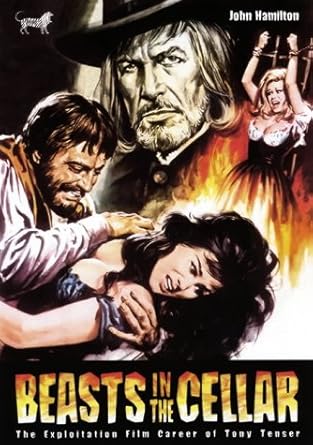
Hamilton, J. 2005, Beasts in the Cellar: The Exploitation Film Career of Tony Tenser, Godalming, FAB Press

Hanson, S. 2007, From Silent Screen to Multi-Screen: A History of Cinema Exhibition in Britain Since 1896, Manchester, Manchester University Press

Hantke, S. ed. 2004, Horror Film: Creating and Marketing Fear, Mississippi, University Press of Mississippi

Hawkins, J. 2000, Cutting Edge: Art Horror and the Avante-garde, Minnesota, The University of Minnesota Press

Hearn, M. 2010, The Art of Hammer, China, Titan Books

Hughes, H. 2004, Once Upon a Time in the Italian West, Padstow, I.B. Taurus

Hunter, I. Q. 2013, British Trash Cinema, Basingstoke, BFI/ Palgrave Macmillan

Jackson, N. 2012, 'Stained With the Blood of the Marketing Department', paper given at Cine Excess, London

Lamberti, E. ed. 2012, Behind the Scenes at the BBFC: Film Classification from the Silver Screen to the Digital Age, London, BFI/ Palgrave Macmillan

Murphy, R. ed. 1997, The British Cinema Book, 1st edition, London, BFI

Nava, M. 2007, Visceral Cosmopolitanism: Gender Culture and the Normalisation of Difference, 1st edition, London, Bloomsbury/ Berg Publishers

Nowell-Smith, G. and Ricci, S. eds. 1998, Hollywood and Europe: Economics, Culture and National Identity 1945-95 , London, BFI

Sarowitz, Sam, 2008, Translating Hollywood: The World of Movie Posters, New York, Mark Batty Publisher

Schaefer, E. 1999, "Bold! Daring! Shocking! True!" A History of Exploitation Films, 1919-1959, Durham, Duke University Press

Shipka, D. 2011, Perverse Titillation: The Exploitation Cinema of Italy, Spain and France, 1960-1980, North Carolina, McFarland

Smith, A. 2012, 'Cowboys and Cannibals: an interview with Ruggero Deodato', Diabolique, Issue no. 8, Jan/ Feb 2012

Spicer, A. and McKenna, A.T. 2013, The Man Who Got Carter: Michael Klinger, Independent Production and the British Film Industry, 1960-1980, London, IB Taurus

Trevelyan, J. 1973, What the Censor Saw, Slough, Michael Joseph Ltd

Waller, G. A. 2002, Moviegoing in America, Oxford, Blackwell Publishers