Pit of Darkness opens on a bomb site somewhere in London, still a common thing in the early 1960s. A young boy spots what appears to be a body down amongst the rubble, but when he investigates he discovers the man is still alive. Richard Logan (William Franklyn) slowly comes round and realises that he has been "coshed" by some ruffians. He thanks the boy for his help and makes his way home. When he walks in his wife Julie (Moira Redmond) is shocked: Richard thinks he is only three hours late, but he has actually been missing for three weeks. He has no memory of his whereabouts and spends the next eighty minutes piecing together the mystery: the fact that he works for a company who specialise in making burglar-proof safes might have something to do with it.
Pit of Darkness came late in the career of Lance Comfort, a solid British director who specialised in supporting features, more commonly known as 'B' films. To Hammer fans he will be best known as the director of the now lost comedy The Ugly Duckling (1959) with Bernard Bresslaw, or at least if it is not lost it is a film which no one wants to let out of the Hammer vault. Pit of Darkness forms part of a sort of "Darkness" trilogy in Comfort's career, which was most likely unintentional. He previously directed Daughter of Darkness (1948), as well as the horror classic Devils of Darkness (1965) shortly before he died. Darkness is a good, go-to word to use in a film title, as it can mean different things depending on the theme of the film. In this particular case the pit of darkness in question is purely metaphorical. Admittedly Logan does wake up in a bomb site, a pit of darkness of a sort, but it is the darkness of amnesia which is he trying to claw out.
The film was released with a 'U' certificate from the British Board of Film Censors following some brief cuts. It seems to have been well received. In the December 1961 issue of Monthly Film BulletinPit of Darkness was summarised as having a "Complex, fanciful plot made plausible by effective writing and direction. The pace is brisk, there are some spirited fisticuffs, and there is the personality of William Franklyn - unbeatable in suggesting solid virtues behind a rakish, smooth exterior." In the excellent The British 'B' Film by Steve Chibnall and Brian McFarlane Pit of Darkness is compared to other Lance Comfort films, who despite the low budgets and quick turnaround generally managed to raise them above being merely formulaic: "All Comfort's films are persuasive narratives, marked by absence of sentimentality and the whiff of human reality, by a feeling for melodramatic tension and for thematic contrasts underlined by a visual style which can move into the expressive and the metaphoric." (p. 142-143)
Butcher's Film Distributors were the typical independent distribution company. It appears they were in business as distributors and occasional producers from the early 1930s, mainly with factual short films such as Strictly Vegetarian (1932, unknown) and the occasional western or thriller like Gorilla Ship (1932, Frank Strayer, US: International Film Studios).
They were still submitting films for classification in the late 1970s, mostly of the Hot Dreams (Amore libero, 1974, Pier Ludovigo Pavoni, Italy: Aquila Cinematografica) or French Nympho (Candice Candy, 1978, Renau Pieri, France: Les Films de l'Epeé) variety. According to my 1970 copy of the The British Film and Television Year Book Butcher's were by then based on Wardour Street in Soho and the managing director was the London-born John I. Philips, of whom I'm ashamed to say I know nothing. Butcher's made around twenty feature films, mostly in the 1950s and early 1960s, perhaps the best known being the proto-slasher Cover Girl Killer (1959, Terry Bishop, UK: Butcher's Film Distributors) starring a pre-Steptoe Harry H. Corbett.
A vital point in the plot pivots on Logan's recollection of the song "My Heart is the Lover," which we hear over and over throughout the film, so it is interesting to see that the song was released in sheet music form. This is most likely the only product tie-in for Pit of Darkness. It is an enjoyable thriller featuring safe-cracking, explosions and a blonde femme fatale, played by Jacqueline Jones. When she first appeared on screen I was convinced it was Caron Gardner. The film also features performances from Anthony Booth, later to be Robin Askwith's best mate and Tony Blair's father-in-law, and a young and very beautiful Nanette Newman.
I saw this when it was broadcast by Talking Pictures TV, the freeview channel which is connected to distributor Renown Pictures. If you are a fan of obscure British 'B' movies this is one of the best channels out there. They don't always have the best picture quality, or even the correct aspect ratio, but it is the only place you are likely to see this sort of stuff.
Last weekend I gave a paper on the censorship and legal problems around two Swedish sex education films which were released here in the mid-1970s. I came across this story as it involved Jacey cinemas and the Fancey family, both of whom I had been researching.
The paper was part of the Sex and the Cinema conference at the University of Kent. It was an excellent conference and I met some interesting people. I also had very positive feedback, which is always nice. It's also reassuring to see other people's papers and realise that the areas in which I'm researching are also of interest to other academics, and that I'm not misjudging this whole thing.
You can read the paper on my Academia.edu profile here.
It does not seem to matter how many times I say I'm going to move away from studying sexploitation films, I still seem to end up back here. I was approached a few months ago and asked to contribute a chapter proposal for a journal, or book (I'm not sure) on "X" rated 1960s British cinema, which is of course right up my street. I quickly wrote something, submitted it and promptly forgot all about it, to the point where three months later when I was contacted to say my proposal had been accepted I had no memory whatsoever of submitting one.
So here I am now, attempting to gather my thoughts on Secrets of a Windmill Girl, another "classic" of the 1960s sexploitation scene. Luckily the film has been released on DVD by Screenbound, formerly Odeon Entertainment, on a double-bill with Naked as Nature Intended (1961, George Harrison Marks), a film I have absolutely no intention of writing about (beyond the brief mention it already has in my thesis). It was made for Compton Films by the directing team of Arnold Louis Miller and Stanley Long. Long was the cinematographer on all their projects, and together they had already made the "Mondo" films London in the Raw (1964) and Primitive London (1965) for Compton. It was when shooting sequences for the latter that Stanley Long attended rehearsals for the final revue at the Windmill Theatre. This footage was not used in Primitive London, but would go on to become central to Secrets of a Windmill Girl.
Since the death of producer Vivian Van Damme in 1960, who had been putting on Follies Bergère-style shows since the 1930s, the Windmill had been in decline and closed its doors in 1964. Under the watchful eye of the Lord Chamberlain, theatre censorship meant that nudity was allowed on a public stage, as long as there was no movement, the logic being that we had naked statues in public and they were fine. The Windmill, being a theatre rather than a strip club, had to follow these rules very strictly, but the 1960s saw the rise of the striptease show, as well as "stag" films on 8mm film, which meant that the Windmill's 'Revuedeville' was becoming increasingly old-fashioned in modern-day Soho. The theatre was sold to the men behind Compton, Michael Klinger and Tony Tenser, who converted it into a cinema, which it had originally been until Mrs Henderson turned it into a theatre in 1931. The Windmill had gone full circle.
Klinger and Tenser decided to immortalise the theatre and the Windmill girls and commissioned Miller and Long to make what was in effect their first full-length feature film (they had made the nudist odyssey Take Off Your Clothes and Live three years earlier, but that was basically an hour-length travelogue with no sync sound). It is an odd, cheap-looking film in which the inexperience of the director is matched only by the inexperience of the cast.
A then-unknown Pauline Collins plays Pat, who with her childhood friend Linda (April Wilding, daughter of Lord Harry Pilkington) audition successfully for the Windmill, having ambitions to make it big in the West End. Stage manager Mike (played by Martin Jarvis!) has a soft spot for Linda, who is portrayed as the sensible, shy one, whereas Pat is gregarious and up for anything, which ultimately leads to affairs, psychedelic parties and gang rape. This goes by without a second glance, as her ultimate fate is to become a stripper performing in clubs and stag parties in front of horribly sleazy men who should be at home with their wives. The film actually starts with Pat getting into a sports car carrying balloons with an unknown man, both of whom are clearly drunk. They race around town before crashing headlong into a wall, killing them instantly. Linda, who is now a successful singer, is visited by Inspector Thomas (veteran film and TV actor Derek Bond) in her dressing room, where he breaks the news and asks her to identify the body.
The next day he visits her at home and she begins to tell him the whole sorry story about Pat. The bulk of the film is then made up of scenes from their lives with Linda's well-spoken voiceover. If she is really supposed to be telling all this to the Inspector, she is giving him detail which is totally irrelevant to his investigation. Indeed it is never made clear exactly why he needs to know the story of Pat's life, when surely he needs to spend more time working out why the driver was drunk and how they crashed. Nevertheless we are supposed to believe that he is sitting in Linda's flat listening to her entire life story. This is the source of much unintentional hilarity, such as when we see them as young schoolgirls and Pat, always trouble, encourages Linda to skip school. It is some of the funniest child acting I have seen in a long time, and the little girl playing Pat actually looks towards the camera at the end of her lines as if seeking approval from the director before she walks away. Later in the film Linda seems to think it is necessary to tell Inspector Thomas all about the other Windmill Girls, beginning with how they get up in the morning and travel to work. She even at one point says "Some travelled long distances every day, like Eileen here, who lived way out in Rochester, Kent." That use of the word "here" makes it sound as if she is sitting with the Inspector in her flat showing him all this on her home projector. Or perhaps Arnold Louis Miller is deliberately creating some Brechtian alienation, drawing attention to the artificial construction of the film, mirroring the artificiality of the Windmill shows themselves. Perhaps.
The bulk of the film is made up of dance and cabaret performances on the Windmill stage itself. What is odd is that we frequently see Pat and Linda in the dressing room, getting ready to go on, or standing in the wings, but they never come out on to the stage itself. They never once perform in any of the dances, and often the costumes they are getting into are totally different to those the actual women are wearing once we see the dance sequences. This is because Stanley Long had shot those sequences more than a year earlier, but no attempt is made to match them together, and surely it would not have been too difficult to shoot some extra dance scenes. There are also several scenes featuring the several of the girls going through a new dance routine with their male choreographer, but this dance is never performed on stage in the film. The Windmill is famous for its comedians as well as the girls. Many well-known comics such as Tony Hancock and Peter Sellers got their first breaks by telling jokes between dance routines, but the comedy acts that Stanley Long shot for this are dreary. It is no wonder that when looking back on their time there comedians often comment that the men in the audience would just look at their newspapers instead of listening to the jokes.
The first time we finally see Pat on stage is when she has given up on her West End dreams and become a stripper. She stands in front of a baying crowd who eventually start booing and slow-clapping because she loses her nerve and begins telling them that she's really an actress. In her final scene she is standing on top of a table in a pub in her underwear, and she berates the men, asking them if they would like it if it was their wives up there, before finally screaming and collapsing to her knees as if having a breakdown. And suddenly the closing credits roll, over footage of the fan dance, which by this point we have seen about six times.
So there are many threads and plot points that are left unfulfilled at the end. One would reasonably expect the film to end where it began, with the crash, except this time we would know how Pat ended up in that car. After all, wasn't that why Inspector Thomas had sat through this extended trip down memory lane? But no, we do not even return to the flat at the end for Linda or the Inspector to get a final moralistic word about the dangers of drugs, partying and stripping. And did Linda ever get together with Mike, who has spent most of the film staring at her longingly? We will never know. The film just ends, like they ran out of film or money, either of which is possible I suppose.
Secrets of a Windmill Girl, DVD frame, Screenbound 2011
Another drawn-out sequence of the film discusses the extra activities that were required of the Windmill girls, who were by this point world famous. They would often be used for promotional stunts such as this one above, where they are dressed as sexy cowboys as they ride atop a stagecoach through suburban London. This is just the kind of promotional stunt that could have been cooked up by Klinger and Tenser themselves, who would often use dancing girls at their film premieres or to drum up free publicity.
Secrets of a Windmill Girl, DVD frame, Screenbound 2011
A particularly low point for Pat comes when she visits an agent to get work as as a dancer. He tells her that what he really needs are strippers and encourages her to take her clothes off so he can "check your figure." She's a little on the thin side but he approves nonetheless and gets her work. Whilst this is going on his wife bursts in, straight from a Carry On film. This is one of the few deliberate moments of comedy in Secrets of a Windmill Girl, but is somewhat jarring given that we are supposed to be sympathising with Pat's declining fortunes. As an aside here, I am convinced that they dressed this set with photos from the Compton office. I think that the girl on the wall on the top right of this image is actually Annette Whitely, who had starred in The Yellow Teddybears and The Black Torment for Compton by this point, and who I'm sure would have been mortified to know that she was used in this scene. I can't be sure, but it is an interesting detail if it's true.
Press cutting, Scottish Daily Express, 18 March 1966
When Pat arrives at her first stripping job she finds she is sharing a dressing room with a former rival from The Windmill. This soon descends into a full-on catfight, images of which were used to promote the film. When I purchased most of what remained of the Compton office archive a few years ago amongst the ephemera were a collection of press clippings collected by General Press Cutting Association Ltd of Chancery Lane. It was this collection that prompted me to offer a chapter on the film, and I intend to write at length on the use of clippings by film distributors, and the insight it gives now on the promotion of the film.
Press cutting, Daily Express, 13 April 1966
This image features former Windmill girl Deirdre O'Dea alongside Rey Anton on a platform high up at the top of the theatre. Deirdre had appeared in the film, and Rey wrote and performs the song "Hold It, Babe" with his band The Pro Form during a party scene in a venue that looks like a cave. Given the fickle nature of the pop world, and according to the clipping, Rey is also a scaffolder and he is working on the conversion currently underway.
Press cutting, Evening Standard, 21 Dec 1965
This image was advance publicity for Secrets of a Windmill Girl, and features (left to right): Janet Hall, Wendy Cotellee, Jill Rose, Frances Pidgeon, Aimi MacDonald and Nita Howard, who are described as actresses who will be playing Windmill Girls in a new film titled "The Windmill Girls Story." I have the feeling that even by the time it came out, Secrets of a Windmill Girl must have seemed dated. It feels like it would have been more contemporary with films like Beat Girl (1959, Edmond T. Greville, UK: Renown Pictures), Expresso Bongo (1960, Val Guest, UK: Val Guest Productions) or even Compton's other 'fallen woman' film That Kind of Girl (1963, Gerry O'Hara, UK: Tekli Film Productions). The 1960s was changing rapidly, and it was only one year away from the 'Summer of Love.' Secrets of a Windmill Girl, brief flashes of nudity aside,is naive and quaint, depicting the lives of young people in the mid-sixties as filtered through the contradictory viewpoint of middle-aged men, who both gaze with desire at these sexualised women whilst simultaneously comdemning them for choosing that lifestyle. The Windmill has had mixed fortunes over the fifty years since this film was released. Currently covered in scaffolding, it can be seen here in images I took a month ago on a visit to Soho. It is now a "gentlemen's club" with table dancing, a far cry from the classier entertainment depicted in Secrets of a Windmill Girl, where audiences of both men and women enjoyed the highly stylised and choreographed performances of the "Revuedeville," even if they were not aware of the secrets those Windmill girls kept hidden.
Finally, I recently made a video about what Soho looked like around ten years later. It features a couple of shots of The Windmill, by then a sex cinema. See if you can spot it.
One of the first distributors I began researching for my PhD was Kenneth Rive, who for a number of years ran a company called Gala. He became known as a specialist in French New Wave and European art house cinema during the 1950s and 1960s, but every so often he also produced films under the Galaworldfilm Productions banner. I have finally caught up with possibly one of his best, The Boys from 1962.
(L - R) Rita Webb, Betty Marsden, Patrick Magee, David Lodge
The Boys begins in a court room with very little exposition. We are thrown into a court case as four teenage boys are in the dock on a charge of murder; the stabbing to death of a garage nightwatchman during a bungled robbery. Various witnesses for the prosecution give evidence as to the yobbish, loutish behaviour these boys indulged in around the west end of London on the night in question, whilst their concerned parents look on in horror. This is 1962 after all, when the penalty for a murder conviction was still death.
What is particularly enjoyable about this film is the way in which it deconstructs the narrative, offering a commentary on the unreliable nature of storytelling. Each of these witnesses offers circumstantial evidence that on the surface points to the guilt of these four boys, but it based purely on assumptions that these boys are up to no good, purely because they look like teddy-boys and one of them carries a flick-knife. Even the audience believes they must be guilty, before we hear testimony from each boy in turn, who fills out the details and gives a wider context for each of the stories told by these so-called eye witnesses. Yes, they may have seemed like louts, but really they were just teenage boys out for a good time. Suddenly you begin to believe they must be innocent, and that this film is a critique of the attitudes adults have towards a youth culture they mistrust and don't understand. The drama, with the present taking place in the courtroom and the flashbacks taking us to the night in question, really creates tension and never lets on which way the verdict will go right until the last minute. Like all good courtroom dramas, you feel invested in the outcome. Sidney J. Furie does not pass judgment on these young boys, and creates realistic, likeable characters who are as much the victims of poverty and circumstance as the trouble-makers of a Charles Dickens novel.
One thing that really makes this film stand out is its tremendous cast. Familiar faces follow each other onto the witness stand, such as Roy Kinnear and Wilfrid Brambell, and Felix Aylmer, recently seen as a predatory paedophile in Hammer's Never Take Sweets From a Stranger (1960, Cyril Frankel, UK), is now on the right side of the law as the judge, listening to questioning from both Richard Todd and Robert Morley. One of the boys, Stan Coulter, is played by that irascible raconteur Dudley Sutton, in one of his very first starring roles, and he is brilliant. He goes from menacing thug to wide-eyed innocent, remaining completely believable the whole time. Popular singer and heart-throb Jess Conrad plays one of his friends.
Richard Todd for the prosecution on the left, Robert Morley defending on the right
My desire to watch this film was prompted by an interview I conducted with Aisha Ahmed (now Wills) last summer for a book chapter I was writing on Jacey cinemas. As a teenager in Birmingham she started working for the chain at their offices there before being selected to become the glamorous face of the company. As "Miss Jacey" she was required to attend glittering premieres in London, attend public events and even model for advertising materials. In 1961 she was encouraged to get into the film industry and was offered a small uncredited part in The Boys, as a kiosk girl. Being a Kenneth Rive production, her scene was shot in the Jacey on Piccadilly, which was currently screening the Italian neo-realist drama Adue e le compagne (1960, Antonio Pietrangeli, Italy: Zebra Film), which Rive had retitled Hungry for Love. Also on offer was the creaky striptease spectacular Femmes de Paris (1953, Jean Boyer, France: Hoche Productions), and the advertising for both can be clearly seen in the film.
The boys are causing trouble outside the Jacey
Aisha "Miss Jacey" Ahmed in her cameo role
Her film career was stymied when she refused to appear in horror films, and she continued to work for the Jacey company for the remainder of the 1960s. She kindly sent me a photo taken during the shooting of her scenes.
Aisha discussing her scene between takes with Sidney J. Furie whilst operator Chick Waterson readies the camera. Photo courtesy of Aisha Wills.
The Boys is a great example of Britain in transition. This is a pre-Beatles, pre-sexual revolution 1960s where boys still wear smart suits and go to dance halls for a good time. Jess Conrad may have been a pop star, but his style was soon going to become very unfashionable indeed. The location photography around London reveals bomb sites and Victorian tenements alongside new high-rise blocks under construction (in fact one of the boys works as an apprentice carpenter on one such block). With Furie having apparently told the boys to "rip up the script," their scenes have a freshness and improvised quality which helps accentuate the contrast between their poor working-class lives and the more stilted, formal atmosphere of the court room. These boys could have easily stepped out of a John Osborne play, or one of the "Angry Young Men" films that were still in production during this period. Perhaps the court room nature of the film, or the fact that Sidney J. Furie was not considered part of that British New Wave, means that The Boys is neglected when talking about depictions of youth in British cinema of the early 1960s. It is certainly as much of a 'message' picture as one of Tony Richardson's or Lindsay Anderson's, and these boys feel like Karel Reisz found them when shooting his Free Cinema documentary We Are the Lambeth Boys (1959, UK: Graphic Films). Like that film, here Furie, with Stuart Douglass' script, is challenging audience perceptions and asking for tolerance and understanding towards young people.
Sadly, for aspect ratio fans, the version of The Boys currently available from Talking Pictures TV and Renown DVD has been cropped from it's widescreen in order to fill 16:9 TVs. This is a pity as the photography is excellent, and there are times when information is missing from the edge of the frame because they cut it off, including a crucial final shot in the court room. In these times of restoration and preservation of lost and long-missing films, this is particularly disappointing. Despite this it is still well worth tracking down and deciding for yourself whether these boys did it, or if they are just victims of circumstance.
A few weeks ago I was invited to write a guest blog post for an AHRC-funded project over at the universities of York and East Anglia entitled "Transformation and Tradition in Sixties British Cinema". Obviously I jumped at the chance to be part of a bigger project that ties in so well with my own research interests. Also I am a shameless whore when it comes to the chance to self-publicise. So if you head over to here you can read the post which came out of my MA research into the link between distribution and censorship.
I have just found a new lecturing post at the University of Chichester teaching a video games module on a media studies degree, so some of my reading over the next couple of months is going to be in a totally different field to that which I am currently used to. Should be fun.
I have submitted a proposal for a conference being held in Rome this June. The whole conference is devoted to the giallo, a film genre I have to admit to only now becoming acquainted with. But my desire to expand my academic reach, coupled with the idea of spending some time in Rome again, has prompted me to get on board. I had previously seen The Bird With the Crystal Plumage, and my interest in Mario Bava has been developing for a couple of years now, so it is not impossible that I can find something to say on it! Indeed, I think I have found an angle that fits well with my own research interests, and hopefully will be fairly original for the conference. If I get accepted I'll start presenting some of the research here.
I also found out last week about a three-day conference in Paris on Hammer films. This sounds like my sort of thing too, but writing academically about Hammer is out of my current comfort zone. I wrote about some Hammer films during my degree, but that was a long time ago and I have felt, somewhat arrogantly, that I have "moved on" from Hammer.But it still has a hold over me. By a rough count today I have over eighty Hammer films on DVD and blu ray, and I have written extensively about them for Cinema Retro. I have interviewed stars and directors, and been to loads of Hammer events and conventions. I have had my photo taken with many a Hammer Glamour girl, as well as many of the ageing male stars too. I feel like my problem is that I'm in too deep with Hammer. It is such a vast subject area, that to choose just one small part to present a paper on seems virtually impossible.
Surrounding myself with DVDs today, and looking through the list of suggested topic areas by the conference organisers, I think I have come up with an idea. It has nothing to do with my PhD, but I feel I can justify it by saying I am stretching myself as an academic. If I can speak on a wider variety of subjects, I'm going to get more exposure in the global academic community. This, like I said, is how I justify it to myself anyway. Spending a few hours of a day staring at Hammer DVDs has to be justified one way or another.
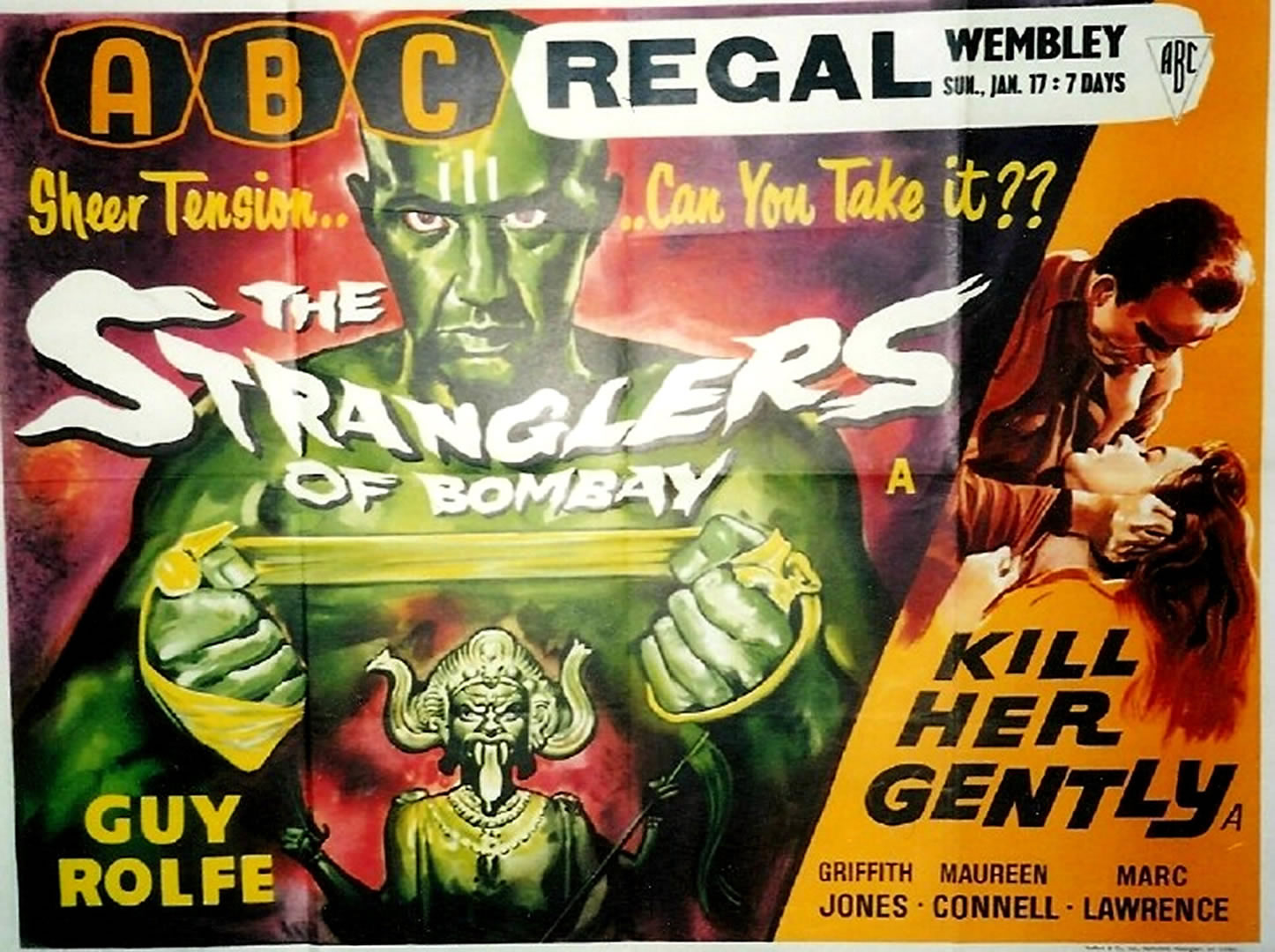
So I think I've narrowed it down to The Stranglers of Bombay and The Terror of the Tongs.
I've also submitted a proposal for a conference on exploitation cinema being held in London this May. So I've gone from doing one paper in the past two years to potentially writing and presenting three within a couple of weeks of each other. Fun times ahead.


 Pit of Darkness came late in the career of Lance Comfort, a solid British director who specialised in supporting features, more commonly known as 'B' films. To Hammer fans he will be best known as the director of the now lost comedy The Ugly Duckling (1959) with Bernard Bresslaw, or at least if it is not lost it is a film which no one wants to let out of the Hammer vault. Pit of Darkness forms part of a sort of "Darkness" trilogy in Comfort's career, which was most likely unintentional. He previously directed Daughter of Darkness (1948), as well as the horror classic Devils of Darkness (1965) shortly before he died. Darkness is a good, go-to word to use in a film title, as it can mean different things depending on the theme of the film. In this particular case the pit of darkness in question is purely metaphorical. Admittedly Logan does wake up in a bomb site, a pit of darkness of a sort, but it is the darkness of amnesia which is he trying to claw out.