Friday, 22 January 2016

Legend of the Witches (1970): A Border Films Production


By the end of the 1960s the Age of Aquarius, once filled with the optimism of a hundred thousand hippies, was going sour. The Manson murders, the Altamont Rolling Stones debacle (not forgetting Sympathy for the Devil) and the rise of Anton LaVey as a celebrity Satanist, hanging out with rock stars and Hollywood A-listers, put the Devil at the forefront of alternative culture. Hack authors like Dennis Wheatley suddenly found themselves back in print with lurid covers usually depicting goat-headed men pawing at naked women, and the idea of witchcraft for many became inextricably linked to sexual freedom. By the early 1970s, if movies and The News of the World were to be believed, the only people getting any sex were wife-swappers and devil worshippers.

Alexander Sanders and his young wife Maxine


Into this rather heady atmosphere, in a typically seedy British manner, stepped Alexander Sanders, who dubbed himself "King of the Witches". He was a Wiccan high priest and talented self-promoter and soon found himself a minor celebrity in the UK. He claimed to have used black magic for most of his life, having been taught by his grandmother, but following the disintegration of his first marriage and family problems which he credited to an abuse of his powers, he decided to use his powers for good. He became a Wiccan in the 1960s, which was well timed for the upsurge in popularity of anything to do with witches and Satanism a few years later.

In 1970 Border Films produced Legend of the Witches, a documentary directed by Malcolm Leigh, who just a year later would direct Lady Chatterley versus Fanny Hill, aka Games That Lovers Play, also for Border. The film, shot in black and white, begins with the night-time initiation rituals of a group of witches. They are all naked with the exception of the priest who wears robes, and they dance in circles around a fire. They also place a blindfold on one man and lead him through the forest, stumbling and falling until he arrives back in the circle. A voiceover, which sounds a bit like Valentine Dyall but most likely is not (sadly there is no credit to suggest who it was), intones throughout the meaning of the rituals whilst also explaining the history of witchcraft, with its pre-christian origins. 

The film is an odd mix of naked witches performing rites, including Alexander and his beautiful blonde wife Maxine, alongside images of old English churches and countryside. Monthly Film Bulletin comically described the film as featuring "a good deal of rather goose-pimply nudity." We even get a tour around the witchcraft museum in Cornwall (which sadly got flooded out several years ago). It is artfully shot for the most part, which may explain how the film got past the BBFC despite the copious full-frontal nudity from both sexes. This would have been one of the last films to be viewed by John Trevelyan, coming in just at the point when the X certificate was changed to mean suitable for over-eighteens only. The BBFC were always more lenient on films which they felt had artistic merit, although it does appear that some cuts were made at the time. Despite the nudity the film is not leering or exploitative, which is possibly surprising given its origins as a Border film. Olive Negus-Fancey is credited as producer, with Malcolm Fancey as an assistant director and his half-sister Judith Smith as editor. This was made by Border around the same time they were producing films like Not Tonight, Darling or distributing European movies such as I Am a Nymphomaniac (1971, France, Max Pecas).

One can only imagine how well this film would have been received by punters at the time. Whilst it could have been viewed in all seriousness as an in-depth documentary on a fascinating subject, it was most likely viewed by men in raincoats in basement cinemas around Soho. These posters I have found online would suggest as much.

The film can now be found in its entirety on YouTube, although rumours persist that there is a much longer cut of the film somewhere. The longest commercially available version is seventy-two minutes, which is the same as this one. If there was a longer version it must be languishing in a vault somewhere, or in Malcolm Leigh's shed. It's well worth having a look at, for a number of reasons. Like many films of this ilk, it's a glimpse into the world of our parents and grandparents that they would rather be left behind. The 1970s was a time in British cinema history when a documentary about naked witches could be found in cinemas around the country, and audiences were willing to sit through the boring bits in order to get to the naked bits. Renown Films appear to have inherited the back catalogue and original elements to many Fancey-produced movies. Their new TV channel Talking Pictures TV has screened Legend of the Witches several times, as well as dozens of other long-forgotten rarities from the Fancey vaults. I am still hoping to be able to visit and take a look in those vaults some time. 

In the meantime my research into the Fancey family continues. I have finally made contact with a member of the family who may be willing to talk about the business with me. I am optimistic that he will.


Tuesday, 1 December 2015

Dick Malloy: Agent 077


I am currently writing about Agent 077, aka Dick Malloy (Ken Clark), an American spy who spends most of his time in Europe either punching bad guys or seducing exotic women. I named this blog after the second of three Agent 077 films, having found lobby cards and this original quad for dirt cheap in a local memorabilia store. Now, thanks to Dorado Films in the U.S. I finally have the out-of-print DVD box set of all three films and am working my way through. As is to be expected, they are entertaining but not amazing. Most of the sixties eurospy films I have seen can be a bit of a slog to get through. Trying to match the thrills and romance of Bond on a quarter of the budget was always going to show on screen, and they often come across as travelogues with the occasional pedestrian car chase and raven-haired beauty wrapped in a towel.

Despite their shortcomings I personally find the whole genre fascinating, and I now have to justify this by writing a chapter of my thesis on them. Ideally I need to turn in the first draft of this, a mere 10,000 words, some time next week.

So, the Agent 077 films are:

Mission Bloody Mary (1965)
From the Orient With Fury (1965, originally titled Fury on the Bosphorus)
Special Mission Lady Chaplin (1967)

All three were directed by Sergio Grieco, under the name Terence Hathaway (a common practice at the time, in order to fool Italian audiences that the film they were watching was American) who clearly had a good relationship with Ken Clark. He made two other eurospy films with him, Tiffany Memorandum (1967) and The Fuller Report (1968). Neither of which are on DVD but are available on YouTube, thanks again to Dorado Films who own videotape versions of these films. They are not good enough quality to release on DVD but they are watchable. I intend to watch all five, as although my focus is specifically on Agent 077, I feel that the other two are relevant to the set. Hopefully they will not be too disappointing.


The eurospy film was massively popular in the 1960s with the majority coming out of Italy, and yet it is very underserved when it comes to legitimate DVD releases. There are probably hundreds that are currently commercially unavailable. This is probably because there is not a lot of mainstream interest in them, which is a pity. Like all popular genres, they tell us a lot about national identity and the times in which they were produced. The costumes, haircuts, cars, etc. are often a far more authentic depiction of their era than the big-budgeted Bond films, which have for the most part achieved a kind of timeless quality.

I have written a large article for a future issue of Cinema Retro on another eurospy film, Bonditis (1968), a one-off spy spoof from Switzerland, which I have probably mentioned on here before. I will also be writing about that for this PhD chapter, depending on how close I get to 10,000 with Agent 077.

I often get asked why I spend so much time with films that no one else (i.e. in the mainstream) has ever seen or heard of. Even I have to admit that watching obscure cinema is something of a crapshoot, but for every five bad or boring films (I saw Sharknado 3 last week, and that was terrible), you find a gem. Maybe. 


Tuesday, 10 November 2015

Arrow Video and Mario Bava


I have once again been invited to contribute to a blu ray release from those great people at Arrow Video. As I have been discovering the world of Mario Bava over the last two or three years it is perfect timing. I have been able to draw on the research I conducted for my paper on the Fancey family back in May AND my giallo paper in Italy in June. Also over the summer I wrote a chapter for Routledge on the Jacey cinema chain, which turned out to be directly relevant to my PhD after all. Part of that research involved interviewing the last surviving member of the Jacey family, John N. Cohen, who had personal dealings with the Fancey family, so this has all neatly dovetailed together. 

I am trying where possible to use things I am writing towards my PhD, which as far as I can tell is fine, but it does mean that by the time the thing is finished most of it will already have been published elsewhere, and I can kiss that offer of publishing it as a book goodbye. Still, I can't worry about that now. I just need a finished PhD, and then I can write books about anything I want.

Speaking of which, I am still working on Norman J. Warren's book. He is now shooting a new movie, which is exciting but does give me another chapter to write. I have interviewed several more people for it in the last couple of months, so I really hope I can get it finished within the next twelve months. It's driving me slightly insane.

Anyway, to be involved with Arrow is exciting again. I have written an essay on the Fancey family who were behind the distribution of Five Dolls For an August Moon. They also attempted, fairly unsuccessfully, to distribute Bay of Blood too. There is some overlap here with my essay for the Mark of the Devil blu ray, as that was also handled unsuccessfully by the Fanceys. As far as I can tell, despite Five Dolls For an August Moon receiving an X-certificate, with no cuts required, it looks like they just let it sit on a shelf. Seeing that the Fancey family archive appears to have gone up in smoke, it's likely that I will never know.

The new Arrow blu ray is due out on the 1st February 2016, and marks the third time now that I have been involved with them, and it is the fifth time I have contributed to a blu ray release (the other two being the BFI and Shameless). I hope there will be plenty more in the future...

Tuesday, 8 September 2015

Not Tonight, Darling


My research interests, much to my chagrin, have often brought me back to the British sex film of the 1970s. I was even referred to as an "expert" in this field by fellow academics at a recent conference. This I find highly embarrassing. However, despite trying to get away from that field in the last few years, I do still find that my curiosity occasionally gets the better of me.

The new freeview channel Talking Pictures TV, an offshoot of the Renown DVD label, have acquired the catalogues of several small British distributors, including the titles owned by Adrienne Fancey. This has meant that I've kept an eye on the channel over the last couple of months. They have been screening long-forgotten films that the Fanceys produced and distributed as well as an assortment of other rare and often unmemorable movies. Amongst these have been some British sex comedies and dramas from the 1970s, a bleak period in our nation's film history when actors were forced into drab, badly written movies for the entertainment of raincoat-wearing audiences. These movies were generally always profitable and therefore producers would rather make them than take a risk on something more wholesome or artistic. I am sure that when people like Luan Peters were taking their clothes off in grubby, brown bedrooms, they had little idea that the films would still be playing to audiences some forty years later.

Which brings us to the Border Films-distributed Not Tonight, Darling (notice how the poster drops the comma), one of many films of that period to serve up the "bored housewife seeks extra-marital sex" plot-line. If the films and TV of the 1970s are to be believed, all wives were gagging for it, their husbands were too dull to notice, and it was left to an army of milkmen, window-cleaners and travelling salesmen to service their needs.

Luan Peters, perhaps best remembered for getting being bitten on the boobs by a Collinson twin in Twins of Evil (also 1971), plays Karen. Her prudish husband John (Jason Twelvetrees) commutes to a solicitors in London every day whilst she takes her young son Gary (Lance Barrett in his only film role) to school and then wonders around shopping and having drinks with friends. She is desperate to get some sex, or even attention, from her husband, but he is blind to her needs and only thinks about work.


What she doesn't realise however is that moustachioed shop-assistant Eddie (Sean Barry-Weske) is a peeping tom, and hovers outside her bathroom window at night in the hope of seeing her apply some moisturiser to her arms. Whenever she does appear his binoculars struggle to maintain focus, much like the audience at this point one imagines. 

Eddie gets into a conversation with the smooth-talking stock supplier Alex (Australian actor Vincent Ball, who was approaching fifty at the time) at work the next day and they get chatting about Karen. Alex is clearly a player, and bets Eddie £5 (a lot of money in those days) that he can get her into bed by the end of the week. This being a film where we are expecting sex, that is precisely what happens. Alex picks her up in a bar and plies her with drinks. He then, for no obvious reason, takes her to watch the band Thunderclap Newman rehearsing. This scene is purely there to fill five minutes, as they just sit and watch, with Alex clicking his fingers like he is really hip, whilst this hairy sixties bunch play a whole song. This photo is the closest I could find to how they look in the movie.


The expression most of them have during this scene suggests that none of them know why they are there either.

Alex takes Karen back to his bachelor pad, which screams "serial killer". It's an almost bare room with only seventies curtains and photos from porn mags for decoration. I am sure I had curtains like this in my home when I was a child.


Despite all the signs to the contrary, Karen is talked into stripping and shagging. Little does she know that Alex has a photographer secreted in a cupboard documenting the whole thing, in order that he can prove to Eddie that he scored and thus claim his £5. He is one class act. 

Karen returns home feeling guilty but liberated. That night she tries to give her husband a blow-job and he leaps out of bed, horrified. He demands that she never tries anything like that again. What a guy.

The next day Alex collects his winnings and celebrates by dropping a copy of the photos through Karen's door, in order to effectively blackmail her into coming with him again. She ends up at a sex party featuring hairy men and women dancing and shagging. One of these women, Suzanne, is actually the notorious horse-faced porn star Fiona Richmond in her feature-film debut. She is credited as Amber Harrison (her real name is Julia Rosamund Harrison).


Not Tonight, Darling treats us to some amusingly choreographed coupling before the camera pans to a large mirror on the wall, where we are let into the secret: it's a two-way mirror! And someone is filming this without anyone else knowing! Shock, gasp.

Sometime later Karen's husband John is taken to a strip club in Soho by grateful client Captain Harrison (Bill Shine, who in better times had appeared in The Red Shoes (1948) and other British classics) where he is presented with a hilarious striptease act by The Tiffany Sisters, who appear to have been real Soho strippers. The club itself is a tiny panelled preview cinema, and these girls dance and strip in front of just five men like their clothes are on fire. It is about as erotic as that sounds. Although the Captain is enjoying himself, and is something of a connoisseur when it comes to Soho strippers, John looks unmoved or unaroused. However, when a film comes on called Willing Flesh, which features his wife in a starring role, he promptly runs to the toilets and throws up. 

Which brings us to the final scenes. He confronts Karen, calling her every name he can think of. She is tearful and sorry and tries to explain, but he is having none of it, and instead plans to take his son and return to his mother's house. Karen tells her friend Joan (Nicki Howorth) about the film, who by coincidence was also at the sex party. Joan then plans a revenge on Alex and his cameraman which involved kidnapping them both, stealing their clothes and dumping them in the countryside, filming the whole thing. We then cut back to a sad and wistful Karen at the bonfire party they had planned before all this happened, wondering whether she can persuade John to stay. And then the credits role, before we know what might become of them.

So what have we learned? Is this film a warning to housewives everywhere? No matter how little sex you are getting from your husbands, it's better than ending up in illegal hardcore porn? Like most of these sex-themed dramas, there is a moral judgement on the film's participants. The actors already feel bad for having to get their clothes off so often, yet their characters don't even get to enjoy it, having to suffer for their behaviour. There are also dead-ends in the plot, most notably with the peeping tom. We see a lot of him in the beginning, and we suspect that he is going to be a major character, but he then disappears, bumped from the screen by Alex. It is interesting that Karen seems to be the only person properly punished, yet she was driven to desperation by her husband's lack of attention. Eddie ought to have been arrested to spying on women through their windows at night, but it's seen as just a harmless hobby. Alex may have to get home naked, but there is little suggestion that he will not be returning to play the field once more.

Considering the likelihood of any bored housewives seeing this in cinemas was pretty slim, one can't help but wonder who was buying this conservative morality. The audience would most likely have been men hoping to see boobs, and they were rewarded for their suffering through the tedium of it all. The only real reason Karen is punished is to get the film past the BBFC. If she had enjoyed it all and not been suitably chastised it is likely that they would have refused a certificate. As it is there are several obvious cuts during the sex party scene, where things were literally cut from the print, leaving jumps in the music. Not Tonight, Darling is also an odd mix of drama with some comedy, most notably the kidnapping of Alex, which is the kind of ending one would expect in a Confessions of... film.

This was directed by Anthony Sloman, who according to the IMDB has mostly worked as a dubbing editor since the 1960s, and has credits on dozens of TV shows. He directed one other feature, Foursome (1972). No prizes for guessing the genre.


Not Tonight, Darling was one of the many sex films distributed by Border Films, which at that time was situated on Wardour Street in Soho next door to the famous Marquee Club. The day to day operations were taken care of by E.J. Fancey's common-law wife Olive Negus-Fancey and her son Charles.

Part of me hopes that this is the last British sex drama/ comedy I sit through, as they are dispiriting and depressing in many ways. Yet I am sure that once enough time has passed I will probably dip my toe in those murky brown waters again. 


Thursday, 3 September 2015

X-Ploitation: How independent film distributors battled against the BBFC and won


A few weeks ago I was invited to write a guest blog post for an AHRC-funded project over at the universities of York and East Anglia entitled "Transformation and Tradition in Sixties British Cinema". Obviously I jumped at the chance to be part of a bigger project that ties in so well with my own research interests. Also I am a shameless whore when it comes to the chance to self-publicise. So if you head over to here you can read the post which came out of my MA research into the link between distribution and censorship. 


I have just found a new lecturing post at the University of Chichester teaching a video games module on a media studies degree, so some of my reading over the next couple of months is going to be in a totally different field to that which I am currently used to. Should be fun.

Thursday, 4 June 2015

Blood Baths and Bloody Brides


The conference in Lincoln went really well. It was good to present some new research, but even better to meet other academics in the same field. One particular stroke of luck was meeting Emma Petts who presented on some research she has been doing into British cinema audiences. This is exactly the kind of research I have been looking for, and hopefully when her own project is finished I may be able to use some of it.

However, another week, another conference. This week I have been writing about the UK reception and marketing of the giallo, ready to fly off to Rome in a few days. I'm very excited to be going to my first overseas conference.
The organisation behind this conference looks amazing. There will be 35mm film screenings, plenty of directors and cast members available for panels, plus two full days of papers being presented by far more knowledgable people than myself. I'm hoping my relative lack of experience in the giallo does not become too noticeable. I'm not writing about the genre or its most famous stars as such, so I ought to get away with it. I'm on the much safer territory of discussing who was distributing these films in the UK and what happened with the BBFC. I'm a little worried that I'm becoming a one-trick pony with all this distribution and censorship stuff. I will probably take a year off conferences after this, so next time I will be have some different (to a point) stuff to present.

This was the first UK release of Mario Bava's Bay of Blood in 1980, eleven years after it was first released in Italy. It is one of the examples I will be discussing in this paper. It was distributed by my old friends New Realm.

Dario Argento's seminal The Bird With the Crystal Plumage on the other hand got away with no BBFC-imposed cuts at all in 1970, but did suffer from this somewhat lacklustre new title.


I will no doubt come back from Rome with an even bigger enthusiasm for all things Italian. Before I first started my PhD back in 2012 I knew or cared very little for Italian horror, and even less for the giallo. It was all about Hammer and Roger Corman as far as I was concerned. Regular meetings with Dr. Leon Hunt changed all that for me, as I began to realise just how significant the Italian film industry was when considering the presence of international film in British cinemas. Even though I am no longer at Brunel University, I am continuing to expand my Italian film experience, enjoying giallos, gothic horrors and Eurospy thrillers. I finally appreciate the great work of Mario Bava, Antonio Marghereti, Lucio Fulci and Dario Argento, and I'm even listening to Goblin.

Thursday, 21 May 2015

E.J. Fancey's Exotic Thrills


Following some deep thought after my last post I realised that trying to write three papers at the same time was more than any sane mind could handle, so reluctantly I dropped the Hammer conference. It will undoubtably be a fantastic event, but I just couldn't do it. Plus it was really straying from my current areas of research so it was purely an indulgence even to consider it.

However, I am going to Lincoln next week to give this paper on the fascinating world of E.J. Fancey. At least, I hope it's fascinating. I've been researching this for a long time, and writing the paper itself has taken me the best part of two weeks. 

I have delved into the Fancey family history to unravel some of the complicated relationships behind his companies, which included S.F. Film Distributors, D.U.K. Films and New Realm Pictures. I have also uncovered original marketing materials and BBFC documentation which highlights the sometimes friendly, sometimes fractious relationship they had with the censors.

I am mainly focusing on the films they distributed rather then their own productions, although they did make several of their own. Largely forgettable is the kindest way of describing them. They did however give Michael Winner his first break as a feature film director, although if you have ever seen Parting Shots (1998) you may not be able to thank them for that.


Karamoja - Land of the Naked People (1965) has to be one of the best exploitation titles of all time. This was actually one of Kroger Babb's films, the American exploitation king who gave the world Mom and Dad (1945) and "She Shoulda Said 'No'!" (1949).


The Fancey's empire, which was eventually run by E.J. himself, his wife, his common-law wife, and his children by both wives, was a major player in the world of independent film distribution in the 1960s.

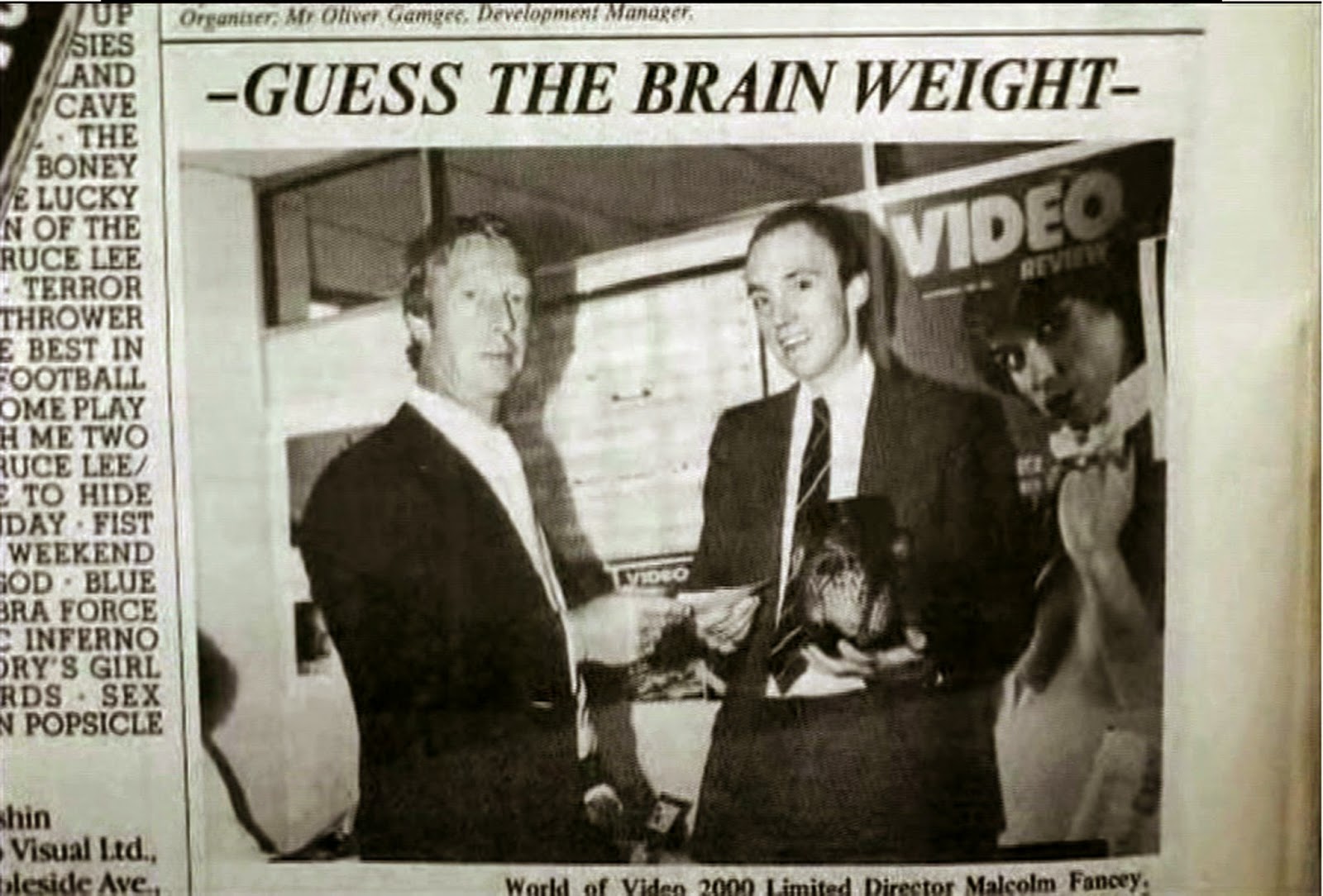
Edwin's son Malcolm had great success in the 1970s by acquiring the rights to Emmanuelle (1975), and he invested the money into making sex films of his own. In the 1980s he gained notoriety for this little publicity stunt to promote Nightmares in a Damaged Brain (1981). This backfired when he and partner David Hamilton-Grant were prosecuted for obscenity because they "accidentally" distributed the version refused a certificate by the BBFC. He got off with a suspended sentence whilst his partner went to prison.

The Fancey's are a fascinating and slightly elusive family that I hope to continue to find more on. I have contacted some living members of the family but have had no success in persuading any of them to speak to me. But I will not give up!

Now that this paper is finished I have to start my giallo one for the Rome conference in three weeks. Oh dear...